"Worked ceaselessly with coolness and efficiency, and her fine example of calmness, courage, and leadership was of great benefit to the morale of all with whom she came in contact." — Official U.S. Army Citation, Pearl Harbor, 1942
Annie Gayton Fox was born on August 4, 1893, in East Pubnico, a small fishing community on the southern tip of Nova Scotia, Canada. Her father was Dr. Charles James Fox, a physician — and perhaps it was his example that first showed her what a life in service to others could look like. Little is documented of her early years, but what came after speaks plainly enough.
In 1918, near the close of the First World War, Annie Fox made the decision that would define the rest of her life: she enlisted in the United States Army Nurse Corps. She was 24 years old. The Army was desperate for trained nurses, the vetting was rigorous, and the commitment was open-ended. She passed. She would not leave the Corps for 27 years.
After her WWI-era service ended in the summer of 1920, she began a long arc of postings that would take her across the continent and around the world — New York, Fort Sam Houston in Texas, Fort Mason in San Diego, Camp John Hay in the Philippines, Manila, and finally, in 1940, to the island of Honolulu, Hawaii. She rose steadily through the ranks, earning the confidence of every command she served under.
On August 1, 1941, Annie Fox was promoted to Chief Nurse — the natural culmination of over two decades of service and demonstrated leadership. That November, she was transferred to Hickam Field's Station Hospital, a 30-bed facility staffed by six nurses, positioned on the Army's primary airfield in Hawaii, immediately adjacent to Pearl Harbor.
She had been at her new post fewer than four weeks. By all accounts it was a happy assignment. Lieutenant Monica E. Conter described the unit as "the happiest group of nurses anywhere, under the grandest chief nurse who enjoys everything as much as we do." A small team, a beautiful island, quiet work. No one knew what was coming.
On the evening of December 6, the nurses of Hickam Field went to bed in peacetime. A fleet of 353 Japanese aircraft was already at sea, heading toward the islands. By morning, everything would be different.
The Japanese aircraft flew so low over Hickam Field that the nurses could see the pilots in their cockpits. One bomb carved a 30-foot crater twenty feet from the hospital wing. Another fell just across the street. Smoke and burning fuel were so thick that the entire staff donned gas masks as they worked. Within minutes of the first wave, American casualties began flooding the 30-bed facility.
Annie Fox did not hesitate. She assembled her nurses and immediately organized the wives of military officers and NCOs who had rushed in from the base to volunteer. She set them to work producing hospital dressings by the hundreds. She directed triage — who needed surgery, who could wait, who needed emergency transfer to larger hospitals elsewhere on the island. And she herself went into the operating room and administered anesthesia during the heaviest part of the bombardment, while the building shook and bombs fell around her.
During the attack, Lieutenant Fox, in an exemplary manner, performed her duties as head nurse of the Station Hospital… worked ceaselessly with coolness and efficiency, and her fine example of calmness, courage, and leadership was of great benefit to the morale of all with whom she came in contact.
— Official U.S. Army Citation, signed by Brigadier General W.E. Farthing · Pearl Harbor, 1942The attack on Pearl Harbor killed 2,403 Americans and wounded 1,178 more. Through the chaos of that morning — the noise, the smoke, the constant arrival of broken and dying men — Fox's six nurses held their posts without exception. Not one left. Under her command, they received, stabilized, and cared for hundreds of casualties in a facility built for peacetime sick call.
Fox was 47 years old. She had served the Army for 23 years and never been in combat. She would later recall no dramatic moment of decision — only the work in front of her, the training in her hands, and a complete inability to watch someone suffer without trying to help.
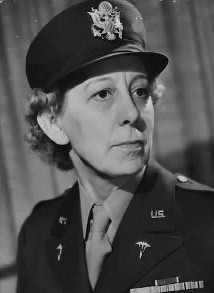
Ten months after the attack, a ceremony was held at the same airfield where the bombs had fallen. Colonel William Boyd, Post Commander, read aloud the citation signed by Brigadier General W.E. Farthing. First Lieutenant Annie G. Fox was awarded the Purple Heart — becoming the first woman in American history to receive the decoration.
At that time, the Purple Heart did not require that the recipient be physically wounded. It could be awarded for "any singularly meritorious act of extraordinary fidelity or essential service." Fox had not been hurt in the attack. She had simply refused to stop working, refused to leave her patients, and refused to let fear drown out duty.
In 1944, the criteria for the Purple Heart were amended to require wounds received in enemy action. Fox's medal was formally replaced by the Bronze Star Medal — which carried the identical citation language from 1942. The United States Armed Forces has continued to recognize her as the first woman to have received the Purple Heart.
She continued to serve after Pearl Harbor — transferring to Letterman General Hospital in San Francisco, then to Camp Phillips, Kansas, where she was promoted to Major. She retired from active duty on December 15, 1945, two years before President Truman would sign the Women's Armed Services Integration Act granting women full military standing across all branches of the Armed Forces.
Annie Fox never married. After retiring from the Army, she settled in San Diego to be near two of her sisters. She died on January 20, 1987, in San Francisco, at the age of 93 — having outlived the war, the century's midpoint, and most of the women who served beside her.
In 2017, Hawaii Magazine recognized her among the most influential women in Hawaiian history. That same year, the U.S. Department of Veterans Affairs named its automated digital health messaging program "Annie" in her honor — a system that today delivers personalized health reminders to veterans across the country.
She is held in the permanent record of TheBestofAmerica.org because an archive's purpose is to make the forgetting impossible. Every generation that comes after this one deserves to know her name and to understand that courage, in its truest form, looks nothing like a movie poster. It looks like a 47-year-old nurse in a gas mask, administering anesthesia in a 30-bed hospital, while bombs fall twenty feet away, because someone needs her and she is there.
Major Annie Gayton Fox. United States Army Nurse Corps. Twenty-seven years of service. The first woman in American history to receive the Purple Heart. She was magnificent.
"Worked ceaselessly with coolness and efficiency, and her fine example of calmness, courage, and leadership was of great benefit to the morale of all with whom she came in contact."