★ Honoree Profile · Veteran
Desmond T. Doss
Corporal · U.S. Army · 1919 – 2006
He carried no weapon into the bloodiest battle of the Pacific — and carried some seventy-five wounded men out of it, one prayer at a time.
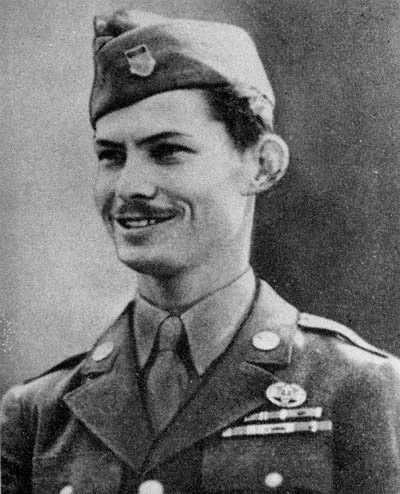
He carried no weapon into the bloodiest battle of the Pacific — and carried some seventy-five wounded men out of it, one prayer at a time.
Desmond Thomas Doss was born February 7, 1919, in Lynchburg, Virginia, and raised a devout Seventh-day Adventist — a faith that taught Sabbath-keeping, nonviolence, and the sanctity of every life. He left school after eighth grade to support his family through the Depression, working first at a lumber company and then as a joiner in a Newport News shipyard.
When the draft came, his shipyard job qualified him for a deferment. He refused it. Doss believed serving his country was a duty — he simply would not kill to do it. Inducted on April 1, 1942, he declared himself a conscientious objector and volunteered as a combat medic: he would go into battle unarmed, and his weapon would be mercy.
At Fort Jackson, Doss's refusal to touch a rifle made him a target. Fellow soldiers mocked him as a coward; some threatened him. He held his ground — and then proved it on the battlefield. In 1944, on Guam and in the Philippines, he twice earned the Bronze Star Medal with "V" device for exceptional valor in aiding wounded soldiers under fire.
The men who had mocked him began to understand: his refusal to carry a gun was not weakness. It was conviction. And on Okinawa, that conviction would save dozens of their lives.
The Maeda Escarpment — Hacksaw Ridge — was a 400-foot cliff of jagged rock on Okinawa, defended by entrenched Japanese forces. When the 1st Battalion assaulted it, artillery, mortar, and machine-gun fire inflicted some 75 casualties and drove the Americans back off the summit. Private First Class Doss refused to seek cover.
Alone in the fire-swept area, he moved from man to man — bandaging, dragging each to the cliff's edge, and lowering him on a rope-supported litter down the rock face to friendly hands. Again and again he went back, praying the prayer that became legend: "Lord, let me get one more." When it was over, no one knew exactly how many he had saved. Doss insisted it could not have been more than 50; his commanders put it at 100. They settled on 75 — the figure that has followed his name ever since.
Days later he was still at it: rescuing a wounded man 200 yards forward of friendly lines under rifle and mortar fire; treating four men cut down assaulting a cave, advancing through grenades to within eight yards of the enemy; braving shelling to administer plasma to an artillery officer; crawling to a wounded American who had fallen 25 feet from an enemy cave, then carrying him 100 yards to safety.
Lord, let me get one more.
Pfc. Desmond T. Doss · Hacksaw Ridge, May 1945On May 21, 1945, during a night attack near Shuri, a grenade explosion tore into Doss's legs — at one point he carried seventeen pieces of shrapnel in his body. Rather than call another medic from cover, he treated his own wounds and waited five hours for litter bearers. When the trio was caught in a tank attack, Doss saw a more critically wounded man nearby, crawled off his own litter, and ordered the bearers to take the other man first.
While he waited for the bearers to return, a comrade began carrying him off the field — and a sniper's bullet shattered his left arm. With magnificent fortitude, he bound a rifle stock to the shattered arm as a splint — a rifle used, at last, not as a weapon but as a bandage — and crawled three hundred yards over rough terrain to the aid station.
On October 12, 1945, President Harry S. Truman placed the Medal of Honor around the neck of Corporal Desmond T. Doss — the first conscientious objector in American history to receive the nation's highest military honor. The man once mocked as a coward stood as the living proof that courage wears many uniforms, and sometimes none at all.
The war cost him dearly. Tuberculosis contracted on Leyte took a lung and five ribs; an overdose of antibiotics left him deaf in 1976 until a cochlear implant restored his hearing in 1988. He raised his family on a small farm in Rising Fawn, Georgia — first with his beloved Dorothy, who died in 1991, then with Frances, whom he married in 1993. He died March 23, 2006, in Piedmont, Alabama, and rests in Chattanooga National Cemetery.
His name endures: his boyhood home in Lynchburg now shelters veterans who were experiencing homelessness, a Lynchburg school bears his name — and the 2016 film Hacksaw Ridge carried his story to a new generation.
"Through his outstanding bravery and unflinching determination in the face of desperately dangerous conditions Private First Class Doss saved the lives of many soldiers. His name became a symbol throughout the 77th Infantry Division for outstanding gallantry far above and beyond the call of duty."
He carried no weapon into battle.
He carried seventy-five men out of it.