★ Founding 250 · World War II Veteran · Pearl Harbor · December 7, 1941
Doris “Dorie” Miller
Mess Attendant Second Class, U.S. Navy · USS West Virginia (BB-48) · Navy Cross
The Navy of 1941 kept Black sailors in the galley, not on the guns. When the bombs fell on Pearl Harbor, a mess attendant from a Texas cotton farm carried the wounded, helped move his dying captain, then took over a machine gun he had never been taught to use — and kept firing until he was ordered off the bridge.
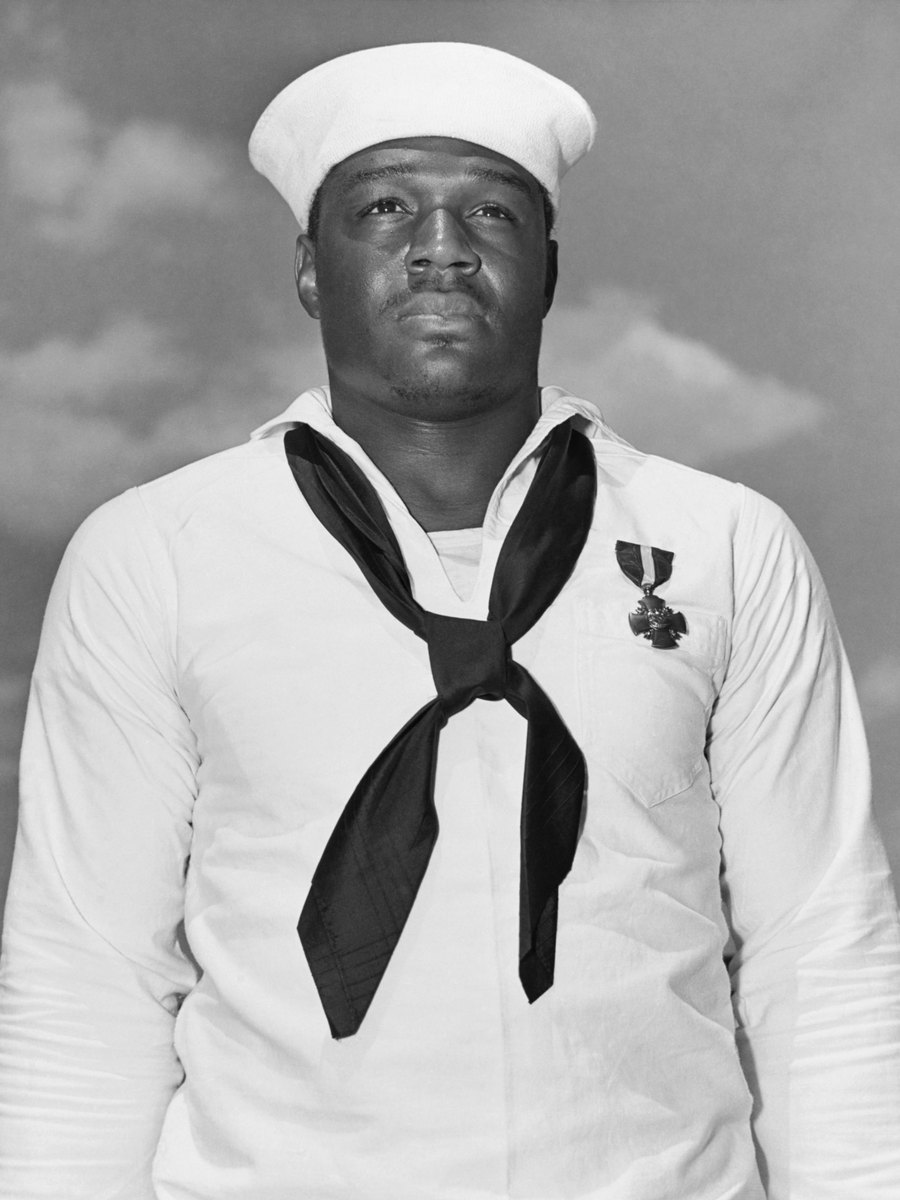
Doris “Dorie” Miller wearing the Navy Cross · 1942 U.S. Navy photo · Naval History and Heritage Command
Branch
U.S. Navy Enlisted 1939
Ship
USS West Virginia (BB-48)
Action
Pearl Harbor December 7, 1941
Born
Waco, Texas October 12, 1919
Lost at Sea
USS Liscome Bay November 24, 1943
Age
24
Decorations
★
Navy Cross
Pearl Harbor, December 7, 1941 · first Black American to receive it · presented by Adm. Chester W. Nimitz, May 27, 1942
★
Purple Heart
World War II
★
Ships in His Name
USS Miller (FF-1091), commissioned 1973 · CVN-81, named USS Doris Miller in 2020
★
01
A Farm Boy from Waco
He joined a Navy that would let him cook, clean, and serve — but not fight.
Doris Miller was born in Waco, Texas, on October 12, 1919, to Conery and Henrietta Miller, one of four sons in a family that worked a farm outside town. Everyone called him “Dorie.” He played fullback at Moore High School and worked his father’s land. On September 16, 1939, at nineteen, he walked into the Navy recruiting station in Dallas and enlisted as a Mess Attendant, Third Class.
In 1939 that was nearly the only job the Navy offered a Black man. Messmen cooked, served officers’ meals, made beds, and shined shoes. They were not assigned to fight the ship. Miller trained at Norfolk, Virginia, served briefly aboard the ammunition ship USS Pyro, and on January 2, 1940, reported to the battleship USS West Virginia. He was big and strong, and he became the ship’s heavyweight boxing champion. In the summer of 1940 he twice went aboard USS Nevada for short temporary duty at the Secondary Battery Gunnery School, and by February 1941 he had been advanced to Mess Attendant, Second Class.
19
His age when he enlisted, September 1939
1,541
Men aboard USS West Virginia that morning
0
Training on the .50-caliber gun he fired
★
02
Sunday Morning
His battle station was gone. So he went looking for the next thing that needed doing.
On the morning of December 7, 1941, Miller was collecting laundry below decks when general quarters sounded. Japanese torpedoes had already torn into West Virginia’s port side. His battle station, an anti-aircraft battery magazine, had been wrecked by torpedo damage, so he went up on deck. He began carrying wounded sailors to safer places on the burning, listing ship.
Then he was ordered to the bridge to help the ship’s commanding officer, Captain Mervyn S. Bennion, who had been gravely wounded by bomb fragments. Through strafing, bombing, and spreading fire, Miller helped move the dying captain to a more sheltered spot. Bennion refused to leave his post and kept giving orders until he died. He was awarded the Medal of Honor.
★
03
“I Just Pulled the Trigger”
Nobody had ever taught him to fire it. He fired it anyway.
Near the bridge was an unmanned .50-caliber Browning anti-aircraft machine gun. Miller had never been trained to operate it. He took it over and fired at the attacking Japanese planes until the ammunition ran out and he was ordered to leave the bridge. West Virginia was sinking beneath them. Of the 1,541 men aboard that morning, 130 were killed and 52 were wounded. Miller helped pull sailors through oil-slicked water to safety before the ship settled on the harbor floor.
It wasn’t hard. I just pulled the trigger and she worked fine… I guess I fired her for about fifteen minutes.
— Doris Miller, describing December 7, 1941 · Naval History and Heritage Command
Navy Cross Citation · U.S. Navy
“For distinguished devotion to duty, extraordinary courage and disregard for his own personal safety during the attack on the Fleet in Pearl Harbor, Territory of Hawaii, by Japanese forces on December 7, 1941. While at the side of his Captain on the bridge, Miller, despite enemy strafing and bombing and in the face of a serious fire, assisted in moving his Captain, who had been mortally wounded, to a place of greater safety, and later manned and operated a machine gun directed at enemy Japanese attacking aircraft until ordered to leave the bridge.”
Official citation · Presented by Admiral Chester W. Nimitz aboard USS Enterprise, May 27, 1942
★
04
The Medal & the Sea
At first the Navy didn’t release his name. It took months, and a campaign by the Black press, for the country to learn it.
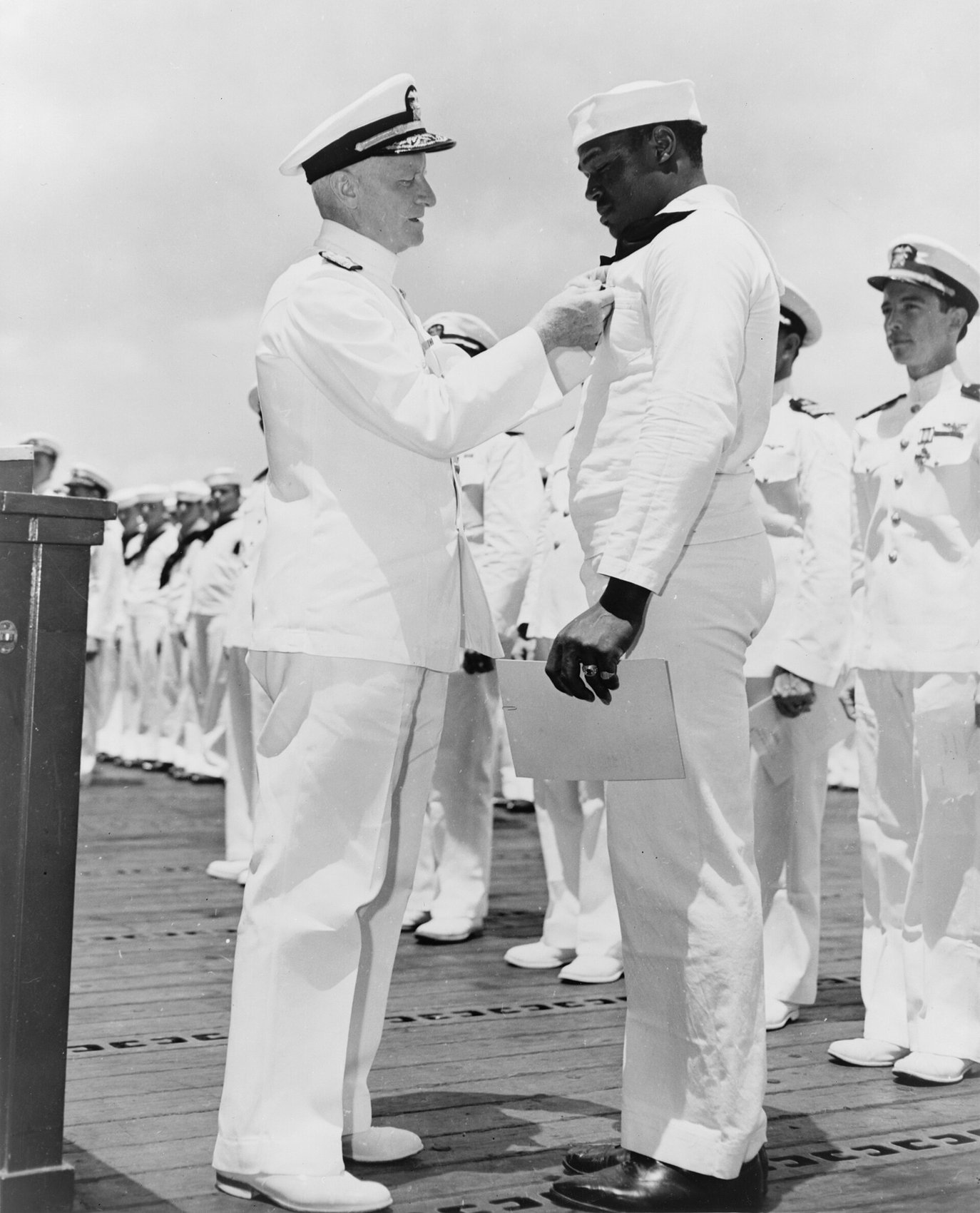
Black newspapers pressed the Navy to identify the messman who had fought back at Pearl Harbor and to honor him. On April 1, 1942, Secretary of the Navy Frank Knox commended him. On May 27, 1942, on the flight deck of the aircraft carrier USS Enterprise at Pearl Harbor, Admiral Chester W. Nimitz, commander of the Pacific Fleet, pinned the Navy Cross on Miller’s chest — the first ever awarded to a Black American.
Admiral Chester W. Nimitz pins the Navy Cross on Doris Miller aboard USS Enterprise at Pearl Harbor, May 27, 1942 · U.S. Navy photo · Naval History and Heritage Command
I’m sure that the future will see others similarly honored for brave acts.
— Admiral Chester W. Nimitz, presenting the Navy Cross to Doris Miller, May 27, 1942 · Naval History and Heritage Command
Miller served aboard the heavy cruiser USS Indianapolis, was advanced to Mess Attendant, First Class, and in 1943 was promoted to Cook, Third Class. In August 1943 he joined the commissioning crew of the new escort carrier USS Liscome Bay. In November, Liscome Bay sailed with the invasion force for Makin and Tarawa in the Gilbert Islands.
At 5:10 a.m. on November 24, 1943, a single torpedo from the Japanese submarine I-175 struck Liscome Bay near the stern. The ship’s bomb magazine exploded, and the carrier sank within minutes. Of her crew, 272 survived and 646 were lost. Dorie Miller was among the missing. A year and a day later, the Navy declared him presumed dead. He was twenty-four. His name is on the Courts of the Missing at the National Memorial Cemetery of the Pacific in Honolulu.
646
Men lost with USS Liscome Bay
5:10
A.M., November 24, 1943 — the torpedo struck
24
His age
★
05
Why He Belongs Here
He was given the smallest job on the ship. On the worst morning in its history, he did the biggest one.
In 1973 the Navy commissioned the frigate USS Miller (FF-1091) in his honor. In 2010 the Postal Service put him on a stamp among its Distinguished Sailors. On January 20, 2020, at a Martin Luther King Jr. Day ceremony at Pearl Harbor, the Navy named a future aircraft carrier, CVN-81, the USS Doris Miller — the first carrier ever named for an enlisted sailor and the first for a Black American. In 2026, news reports said Navy leaders were reconsidering that name; when this profile was written, the Navy had announced no change, and its official records still listed CVN-81 as the future USS Doris Miller.
Whatever any ship ends up being called, the story stays the same. Miller had every reason to believe his country did not see him as a fighting man. The Navy had told him so in the only job it would give him. When the attack came, he didn’t wait to be asked or trained or allowed. He carried the wounded, stood by his captain, and fought with what was in front of him. Anyone who has ever been underestimated, overlooked, or kept in a box someone else built can find something in that: the moment that matters doesn’t ask what your job title is.
Verified Sources
Naval History and Heritage Command — Doris Miller, 12 October 1919 – 24 November 1943, history.navy.mil
Naval History and Heritage Command — Cook Third Class Doris Miller’s Navy Cross Citation, history.navy.mil
Naval History and Heritage Command — Cook Third Class Doris Miller, USN: Transcript of Service, history.navy.mil
U.S. Navy — Navy Names Future Aircraft Carrier Doris Miller During MLK, Jr. Day Ceremony, navy.mil, January 20, 2020
U.S. Congress — Public Law 113-256 (2014), findings on the service of Doris Miller, govinfo.gov
Stars and Stripes — reporting on the future CVN-81’s name, August 28, 2026
Archived in Permanent Honor
“His Navy handed him a mop and a serving tray. On the morning the war came, he picked up a machine gun instead. The Best of America™ will not forget him.”
Doris “Dorie” Miller · U.S. Navy · USS West Virginia · Pearl Harbor, December 7, 1941