Some 500 Marines were trapped on a Guadalcanal beach. A 22-year-old Coast Guard signalman led the plywood landing boats back in to get them, then turned his own boat into a shield between the Marines and the enemy guns. They all got off. His last words were a question about them.
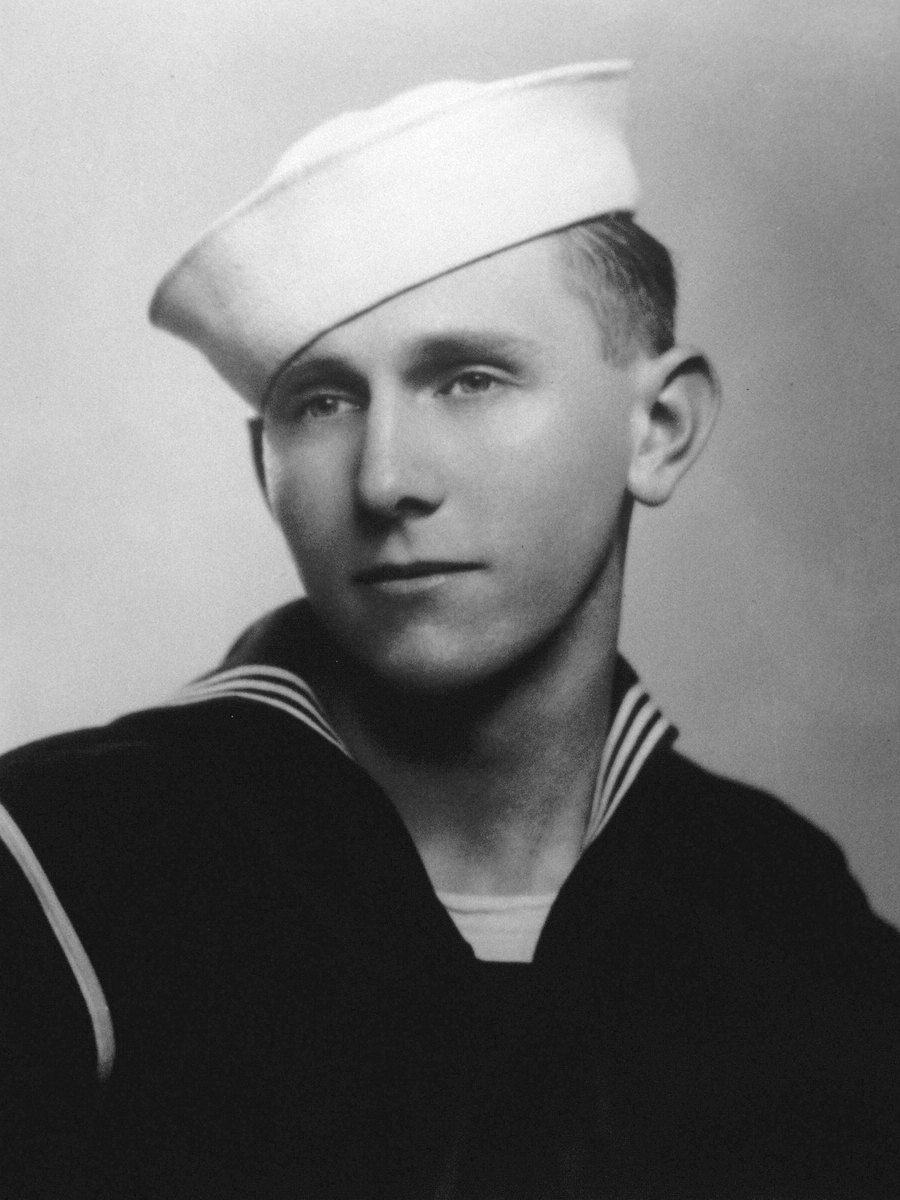
Douglas Albert Munro was born in Vancouver, British Columbia, on October 11, 1919, the only son of James and Edith Munro. When he was a small boy the family moved to Washington State and settled in South Cle Elum, a mining town in Kittitas County. He played in the Cle Elum High School band and the town’s drum and bugle corps, graduated in 1937, and spent a year at Central Washington College of Education.
On September 18, 1939, he enlisted in the U.S. Coast Guard. He served aboard the cutter Spencer, where he earned his rating as a signalman, then pushed for a transfer when the Coast Guard began crewing Navy transports. By 1942 he was aboard the attack transport USS Hunter Liggett, headed for the Pacific with his best friend and fellow Coast Guardsman, Raymond Evans. In August 1942 Munro landed with the Marines on Tulagi, and two weeks later was sent across to Guadalcanal as a signalman at the Lunga Point boat base, under Commander Dwight H. Dexter, USCG.
On September 27, 1942, Lieutenant Colonel Lewis B. “Chesty” Puller sent three companies of his 1st Battalion, 7th Marines, by boat to land west of the Matanikau River near Point Cruz. Munro was put in charge of the landing craft that carried them. About 500 Marines went ashore unopposed around 1:00 p.m. and pushed inland.
Then the Japanese closed in. The Marines’ commander was killed, and the battalion was cut off from the beach. The Marines spelled out HELP with their white undershirts on a ridge, and a pilot overhead spotted it and radioed the message back. One boat that went in early for the wounded was shot up; its Navy coxswain, Samuel B. Roberts, was killed.
Commander Dexter asked whether Munro and Evans were ready to go back and bring the Marines off the beach. According to Evans, Munro answered, “Hell, yeah!” Munro volunteered to lead the boats. His Higgins boat had a plywood hull and two air-cooled .30-caliber machine guns.
Under machine-gun fire from the ridges, he led the boats in toward the shore, signaled them to land, and brought them in by twos and threes to load the Marines. Then he did the thing the Coast Guard has honored ever since: to draw the enemy’s fire away from the heavily loaded boats, he steered his own craft between the Japanese guns and the beach and held it there as a shield, while he and Evans fired back. Every Marine got off the beach, including 25 wounded. On the way out, Munro stopped to help free a grounded landing craft full of Marines.
As the boats pulled away, a Japanese machine gun opened up on them. Evans shouted a warning, but Munro could not hear it over the engines. A single bullet struck him at the base of the skull. Evans took the wheel. Munro regained consciousness only briefly.
Did they get off?
— Douglas Munro’s last words, to Raymond Evans, September 27, 1942 · U.S. Coast Guard Historian’s OfficeEvans told him yes. Douglas Munro died before the boat reached base.
“For extraordinary heroism and conspicuous gallantry in action above and beyond the call of duty as Petty Officer in Charge of a group of 24 Higgins boats, engaged in the evacuation of a battalion of marines trapped by enemy Japanese forces at Point Cruz, Guadalcanal, on 27 September 1942. After making preliminary plans for the evacuation of nearly 500 beleaguered marines, Munro, under constant strafing by enemy machine guns on the island, and at great risk of his life, daringly led five of his small craft toward the shore. As he closed the beach, he signaled the others to land, and then in order to draw the enemy’s fire and protect the heavily loaded boats, he valiantly placed his craft with its two small guns as a shield between the beachhead and the Japanese. When the perilous task of evacuation was nearly completed, Munro was instantly killed by enemy fire, but his crew, two of whom were wounded, carried on until the last boat had loaded and cleared the beach. By his outstanding leadership, expert planning, and dauntless devotion to duty, he and his courageous comrades undoubtedly saved the lives of many who otherwise would have perished. He gallantly gave up his life in defense of his country.”
Munro was buried on Guadalcanal. His commanding officer wrote to James and Edith Munro in Cle Elum to tell them how their son had died.
He received his wound just as the last men were getting in the boats and clearing the beach.
— Lt. Cmdr. Dwight H. Dexter, USCG, letter to Munro’s parents, 1942 · U.S. Coast Guard Historian’s OfficeOn May 24, 1943, at the White House, President Franklin D. Roosevelt presented Douglas Munro’s Medal of Honor to his parents. Within hours, according to the National WWII Museum, Edith Munro — 48 years old — took the oath and joined the Coast Guard Women’s Reserve, the SPARs, insisting on going through training like any other recruit. She went on to command the SPAR barracks at Coast Guard Base Seattle, and on March 8, 1944, as a lieutenant junior grade, she christened the Navy destroyer escort named for her son. She was promoted to lieutenant that July and served until November 1945.
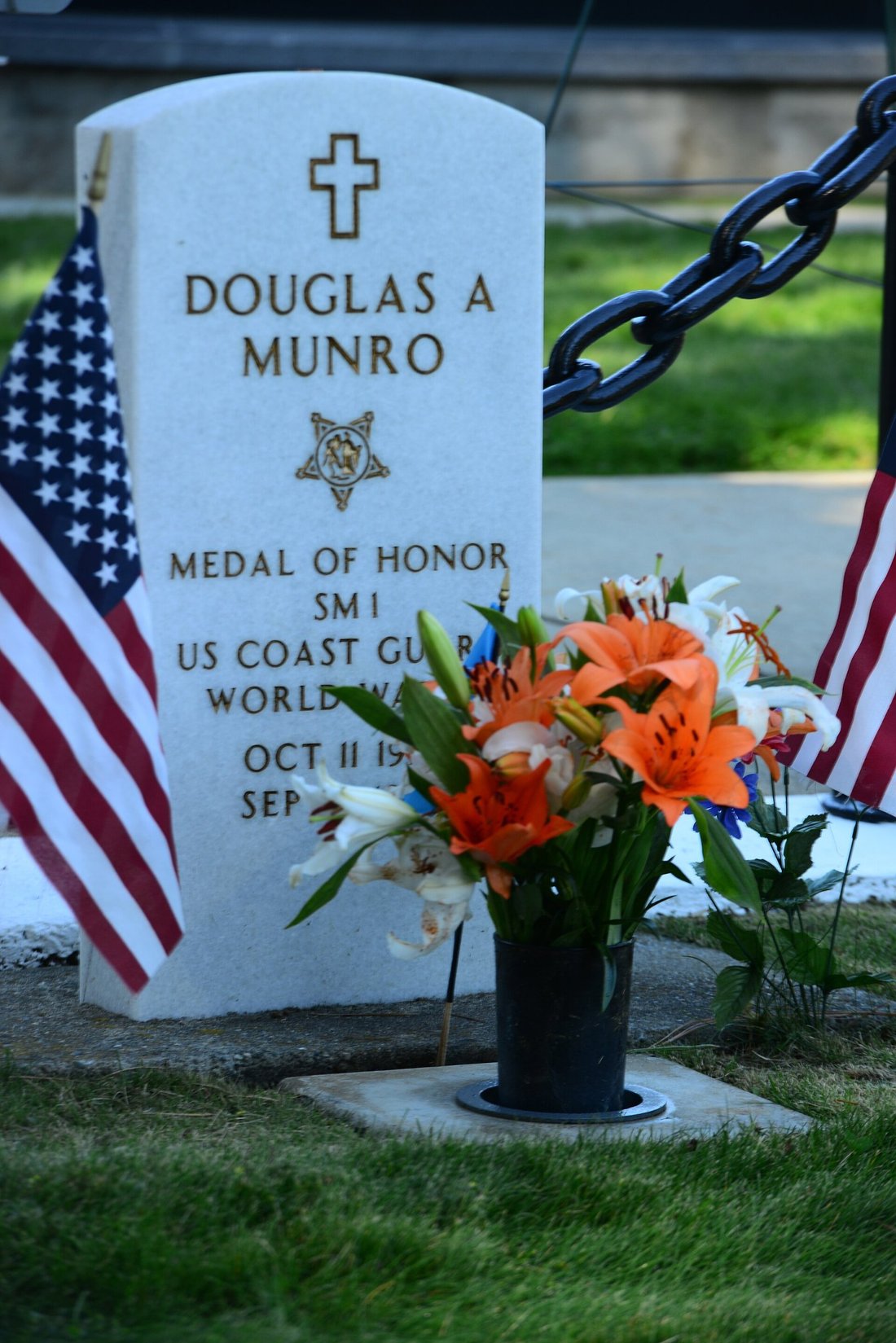
After the war Douglas Munro’s remains were brought home to Washington. He rests in the family plot at Laurel Hill Memorial Park in Cle Elum, beside his mother and father.
Douglas Munro remains the only member of the U.S. Coast Guard ever awarded the Medal of Honor. Three ships have carried his name: the destroyer escort USS Douglas A. Munro (DE-422) and the cutters Douglas Munro (WHEC-724) and Munro (WMSL-755). The Coast Guard’s headquarters in Washington, D.C., is the Douglas A. Munro Coast Guard Headquarters Building, and a statue of him stands at Training Center Cape May, where every enlisted Coast Guardsman goes through boot camp and where his Medal of Honor is displayed. Since 1971 the Coast Guard has given the Douglas A. Munro Award for inspirational leadership to an enlisted member each year.
He had already done his job that day. He had landed the Marines and come back safe. When they called for someone to go back in, he raised his hand, and when the boats were loaded he put himself where the bullets were. His last thought was not about himself. Anyone who has ever been asked to go back into something hard for someone else — a family member, a friend, a stranger — can find something in Douglas Munro’s question. It is the right one to ask: Did they get off?
“He went back in for them, put his boat between them and the guns, and asked about them with his last breath. The Best of America™ will not forget him.”
Become a Founding Local Patriot Business™ → · Sponsor this profile and ensure no American hero is ever forgotten