World Trade Center Site, New York City · Memorial Opened 2011 · Museum Opened 2014
“No day shall erase you from the memory of time.” — Virgil, inscribed at the Museum entrance
Site
16 Acres, Lower Manhattan
Design
“Reflecting Absence”
Memorial Opened
Sept. 11, 2011
Museum Opened
May 21, 2014
Names Honored
2,983 Victims
Architects
Michael Arad & Peter Walker
Designations
★
Bears Witness to Two Attacks
Honors victims of both September 11, 2001 and the February 26, 1993 World Trade Center bombing
★
Largest Man-Made Waterfalls in North America
Twin reflecting pools set in the exact footprints of the fallen Twin Towers
★
Largest Design Competition in History
5,201 submissions from 63 countries · International Memorial Competition, 2003–2004
01
A Clear Morning
Nineteen terrorists, four airliners, and a single morning that changed a nation forever.
On the morning of September 11, 2001, nineteen terrorists affiliated with al-Qaeda hijacked four commercial airliners. Two were flown into the North and South Towers of the World Trade Center in Lower Manhattan. A third struck the Pentagon in Arlington, Virginia. The fourth, United Airlines Flight 93, crashed into a field near Shanksville, Pennsylvania, after passengers and crew fought to retake the cockpit. Both towers, each holding tens of thousands of people that morning, collapsed within roughly ninety minutes of impact.
The attacks were planned and directed by Osama bin Laden, the founder and leader of al-Qaeda, who had declared war on the United States years earlier and had already been linked to earlier attacks on American targets abroad. Bin Laden publicly claimed responsibility for September 11 in a videotape released in 2004, describing the planning in his own words. He was killed by U.S. Navy SEALs in Pakistan on May 2, 2011, nearly ten years after the attacks. Understanding who ordered this and why remains part of why this archive exists — not to dwell on the perpetrators, but so the country never stops asking the question that keeps it from happening again.
Nearly 3,000 people were killed that day — office workers, visitors, airline passengers and crew, and 343 New York City firefighters, 23 NYPD officers, and 37 Port Authority police officers who ran toward the towers as everyone else ran away. It was the deadliest terrorist attack in human history and the single deadliest incident for American law enforcement and firefighters. It was not the first attack on the site: on February 26, 1993, a truck bomb detonated in the World Trade Center’s parking garage, killing six people and foreshadowing the scale of what was still to come.
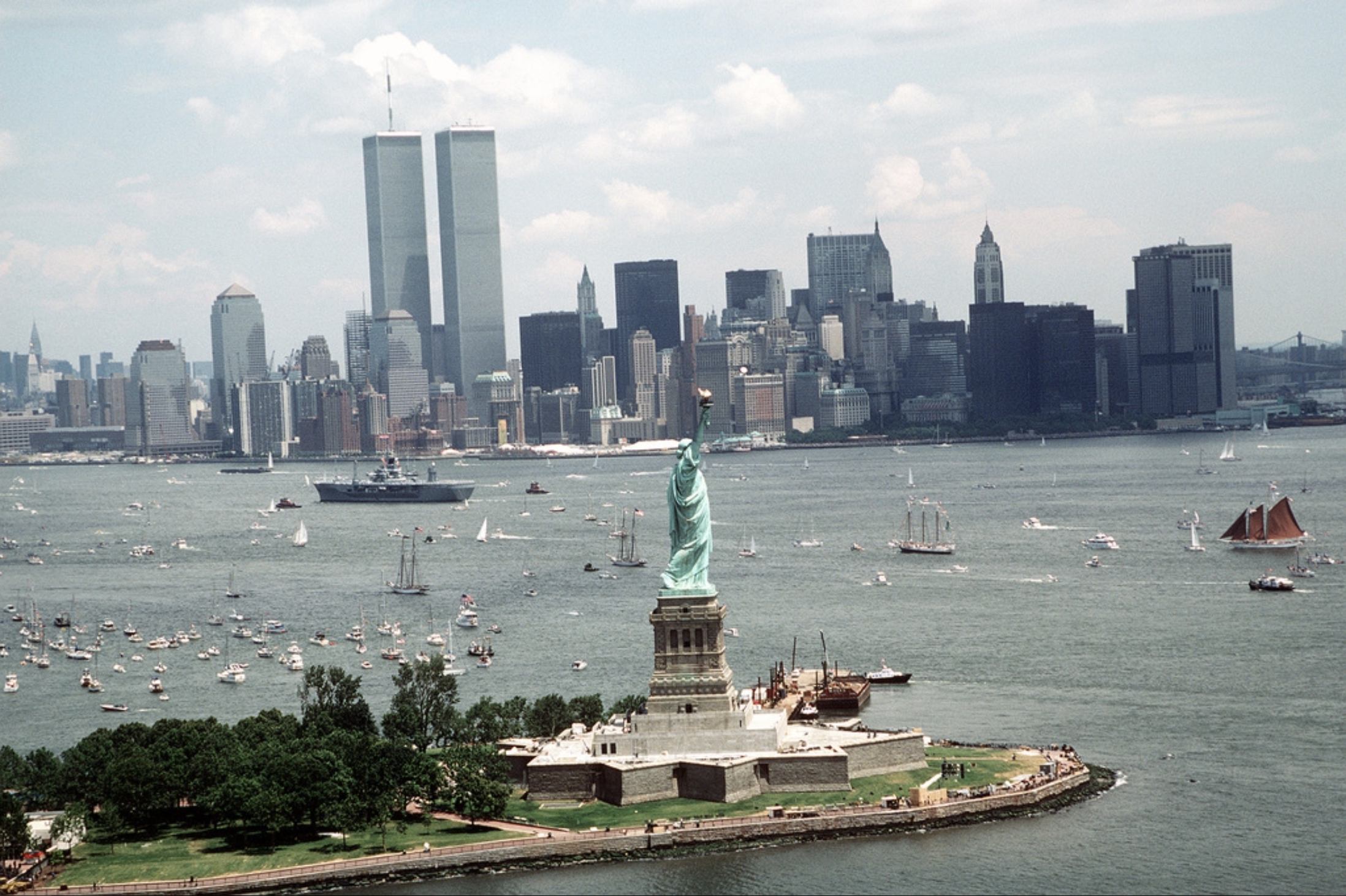
The Twin Towers at their full height above Lower Manhattan, seen from New York Harbor beside the Statue of Liberty
↔ Drag to look around
360° view from the Top of the World Observation Deck, atop the World Trade Center · August 2001, three weeks before the towers fell · Photo: Dheera Venkatraman, released CC0 / public domain
★
02
Choosing a Design
More than 5,000 designs, from 63 countries, for the largest memorial competition in history.
In April 2003, the Lower Manhattan Development Corporation launched an international competition open to any adult, regardless of nationality or professional credentials, to design a permanent memorial at the World Trade Center site. It became the largest design competition ever held: 5,201 submissions arrived from 63 countries and nearly every state in the union. A thirteen-member jury — architects, urban planners, and family members of those who had died — spent months narrowing the field.
In January 2004, the jury selected “Reflecting Absence,” submitted by New York architect Michael Arad and refined with landscape architect Peter Walker. The design placed two enormous voids where the towers once stood — recessed pools fed by the largest man-made waterfalls in North America, set within a plaza of more than 400 swamp white oak trees. Construction broke ground in 2006 and continued for five years, guided by a single unbending requirement: every name would be inscribed, and no visitor would ever be more than a few feet from the footprint of the towers themselves.
Every name would be inscribed. No visitor would stand more than a few feet from where the towers themselves once stood.
— The design mandate given to all 5,201 competition entries · 2003
★
03
Reflecting Absence
Two pools, nearly an acre each, where the towers stood — every name placed beside the people they died with.
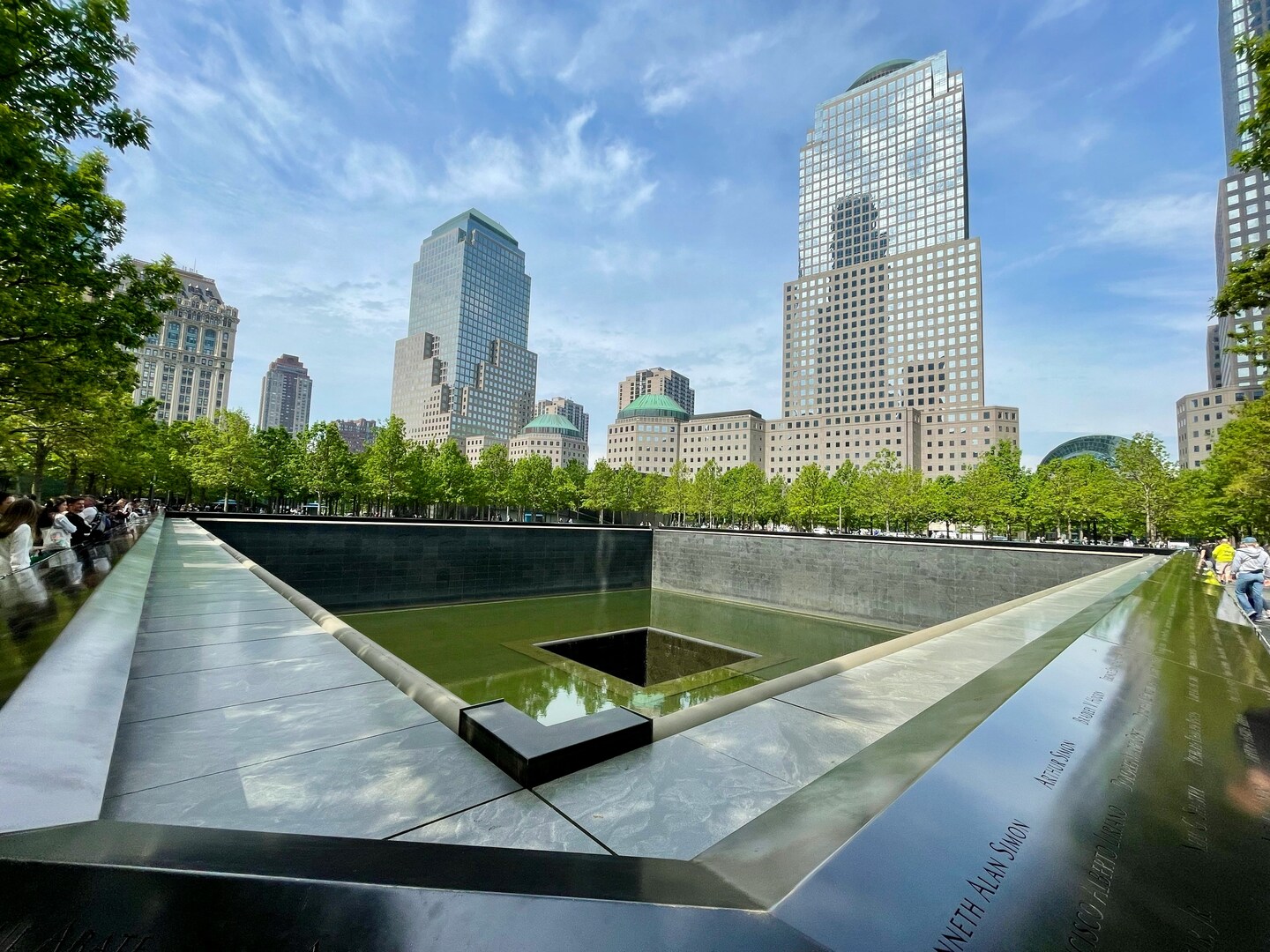
The Memorial opened to the public on September 12, 2011, the day after a dedication ceremony marking the tenth anniversary of the attacks. Its twin reflecting pools sit exactly within the footprints of the North and South Towers, each fed by a thirty-foot waterfall — the largest man-made falls in North America — that pours continuously into a lower basin and then vanishes into a smaller void at the center, a design meant to evoke a loss that can never be fully filled.
Bronze parapets ringing the pools carry the names of all 2,983 victims: the 2,977 killed on September 11, 2001, across the Twin Towers, the Pentagon, and the fields of Shanksville, and the six killed in the 1993 bombing. The names are not arranged alphabetically. Michael Arad and the memorial's planners spent years consulting victims' families to place each name beside colleagues, friends, and loved ones who died alongside them — a system the memorial calls “meaningful adjacencies.” More than 400 swamp white oak trees surround the plaza, and each year on the anniversary, a white rose is placed beside the names of those celebrating a birthday that day.
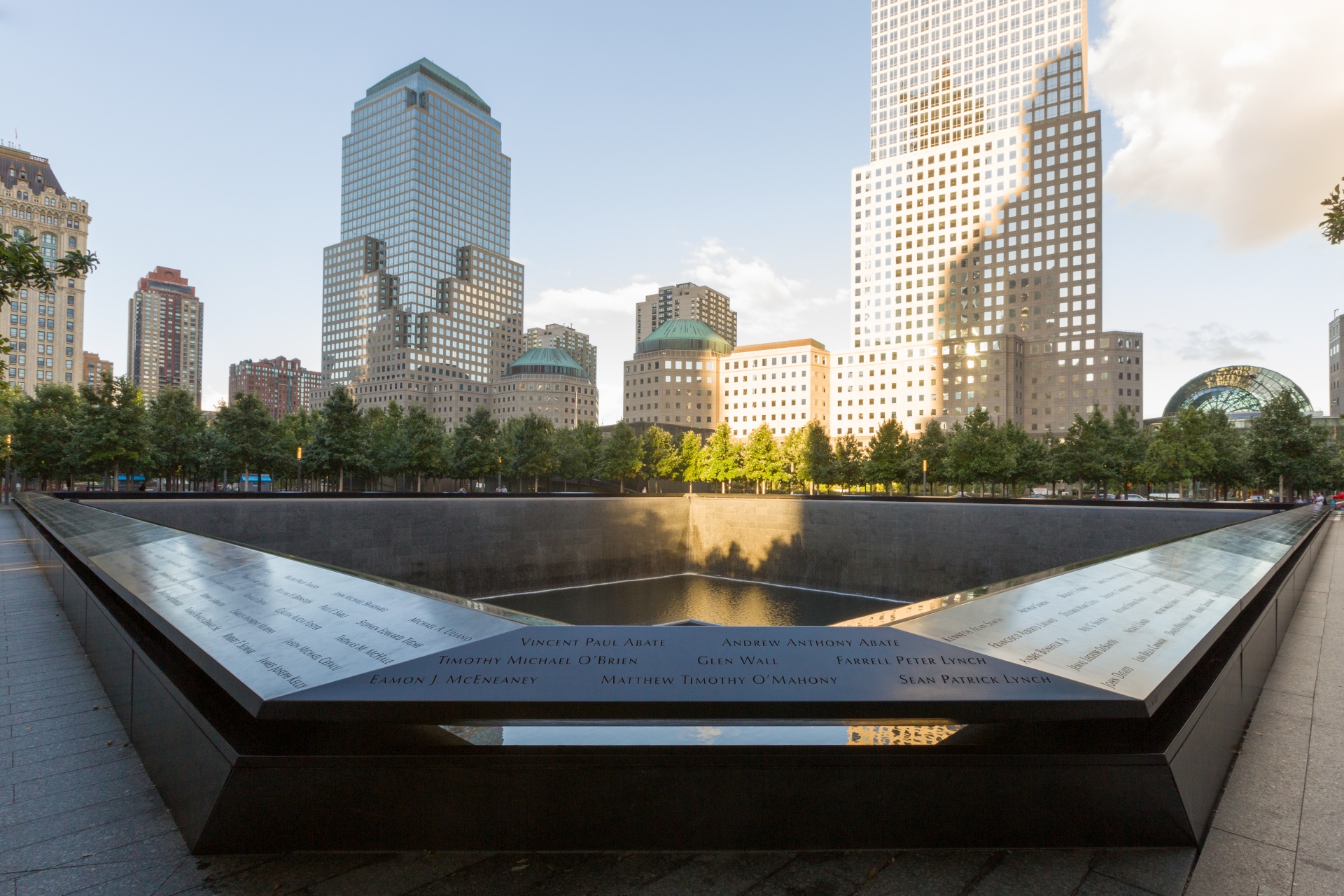
Names inscribed along the North Pool parapet, catching the evening light · National September 11 Memorial, New York City
403 first responders who gave their lives at the World Trade Center · Fire Department of New York, New York City Police Department, and Port Authority Police Department · click or tap to pause
2,983
Names Inscribed
5,201
Design Entries Reviewed
400+
Swamp White Oaks Planted
16
Acres at the Memorial Site
★
04
The Tree That Survived
A crushed pear tree pulled from the rubble. A pathway inlaid with steel. Sixty thousand artifacts telling the rest.
In October 2001, recovery workers found a badly damaged Callery pear tree buried in the debris of Ground Zero, its branches snapped and its trunk charred. Parks workers nursed it back to health at a city nursery for nearly a decade before it was returned to the plaza in 2010, thirty feet tall, and replanted near where it was found. Today the “Survivor Tree” is the only living witness to the attacks still standing on the grounds, and each year seedlings grown from its branches are sent to communities across the country that have endured tragedies of their own.
The museum opened on May 21, 2014, built into the bedrock beneath the plaza and centered on the original slurry wall that held back the Hudson River when the towers fell. Its 110,000 square feet hold more than 60,000 artifacts — twisted steel, recovered photographs, the last column removed from the site, covered in messages from rescue workers — alongside recorded testimony from survivors and family members. In the plaza above, the Memorial Glade, dedicated in 2019, marks a path lined by six stone monoliths inlaid with World Trade Center steel, honoring the responders, recovery workers, and survivors who have since died or fallen ill from exposure at the site.
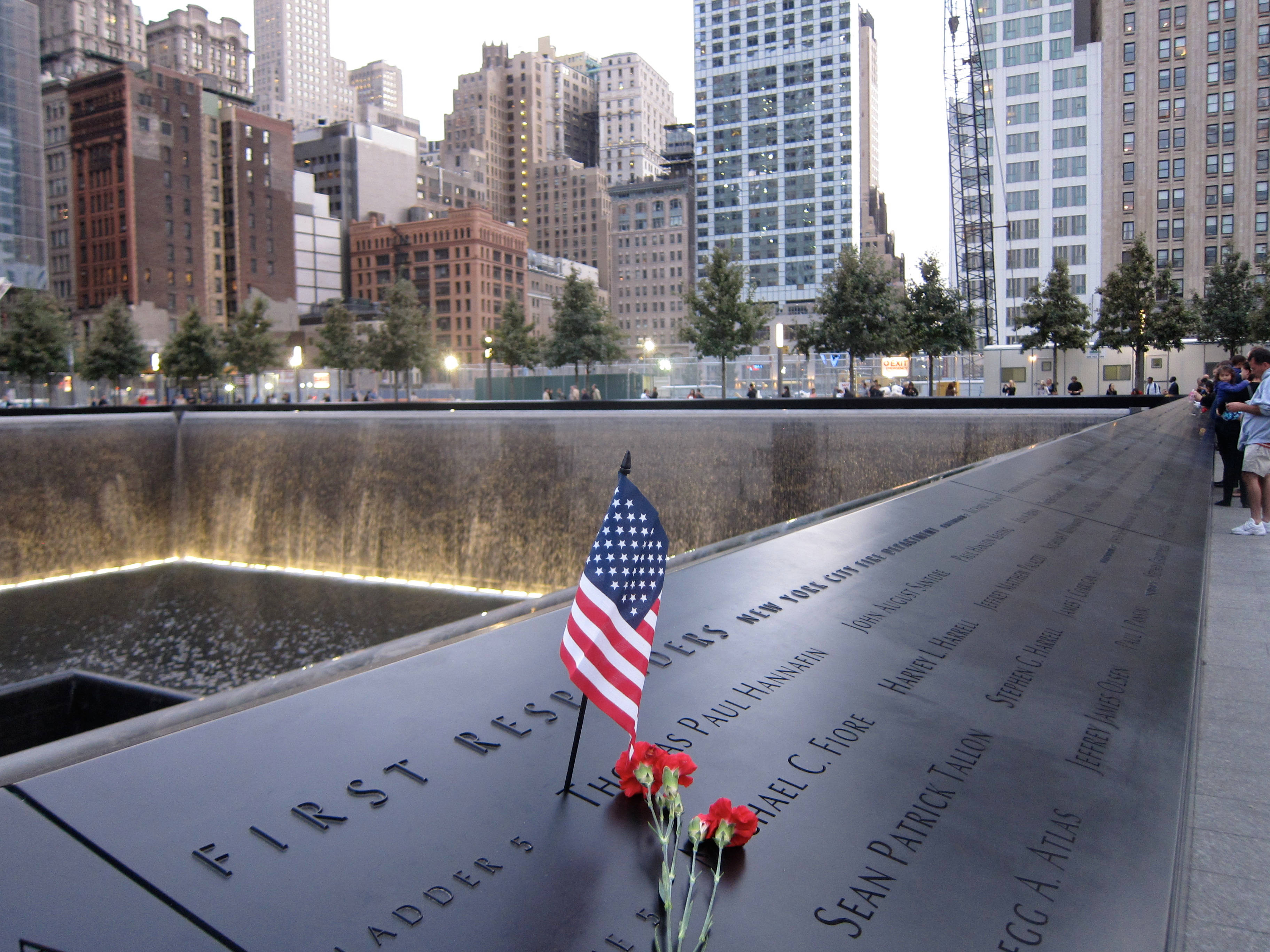
A flag and flowers left at the First Responders panel · National September 11 Memorial, New York City
★
05
Why It Belongs Here
Not a monument to what was lost, but a promise — renewed every year on the same bright morning — that it will not be forgotten.
Every September 11th, families gather at the pools before dawn and read the names aloud, one by one, a recitation that now takes hours. Visitors from all fifty states and more than 190 countries have walked the plaza since it opened. Millions more have descended into the museum below to stand beside the last column, to see the twisted steel, to hear the recorded voices of people who did not know, when they left for work that morning, that it would be the last ordinary day.
This archive exists to remind people of what ordinary Americans are capable of — on their best days and, just as often, on their worst. The 343 firefighters, 23 police officers, and 37 Port Authority officers who ran into the towers as everyone else ran out belong in the same record as the soldiers and community leaders honored elsewhere on this site. The Memorial and Museum do not let that morning fade into abstraction. They hold it in bronze, in steel, in a tree that would not die, so that it remains what it has always been: not history, but memory.
Plan Your Visit & 25th Anniversary Programs
This page is a tribute, not a replacement for the memorial itself. For visitor hours, the official 25th-anniversary commemoration schedule, the annual Reading of the Names ceremony, and museum programs, go straight to the source:
National September 11 Memorial & Museum — About the Memorial, 911memorial.org
National September 11 Memorial & Museum — About the Museum, 911memorial.org
National September 11 Memorial & Museum — The Museum, 911memorial.org
National September 11 Memorial & Museum — About, 911memorial.org
National Commission on Terrorist Attacks Upon the United States — The 9/11 Commission Report (2004)
Lower Manhattan Development Corporation — World Trade Center Site Memorial Competition records, 2003–2004
Archived in Permanent Honor · The Founding 250
“The National September 11 Memorial & Museum is entered into the permanent record of The Best of America National Archive in recognition of the 2,983 lives taken, the responders who ran toward danger, and the nation's unbroken promise to remember. As long as this archive endures, so will this record.”
National September 11 Memorial & Museum · World Trade Center Site, New York City · Est. 2011 / 2014
As long as we remember them, they never truly leave us.