He had spent years insisting the towers would be attacked again, drilling employees who thought he was paranoid. When it happened, he ignored the announcement telling everyone to stay at their desks, grabbed a bullhorn, and started singing to keep 2,700 people calm on the way down — then went back up for the ones still left.
Cyril Richard Rescorla was born in Hayle, a small town in Cornwall, England, in 1939, and grew up on stories of American GIs who had passed through during World War II. He enlisted in the British Army in 1957, trained as a paratrooper, and served with an intelligence unit in Cyprus during the EOKA insurgency. He then spent three years as an inspector in the Northern Rhodesia Police and a short stint with London’s Metropolitan Police before crossing to the United States in 1963 to enlist in the U.S. Army. He went through Officer Candidate School and airborne training at Fort Benning.
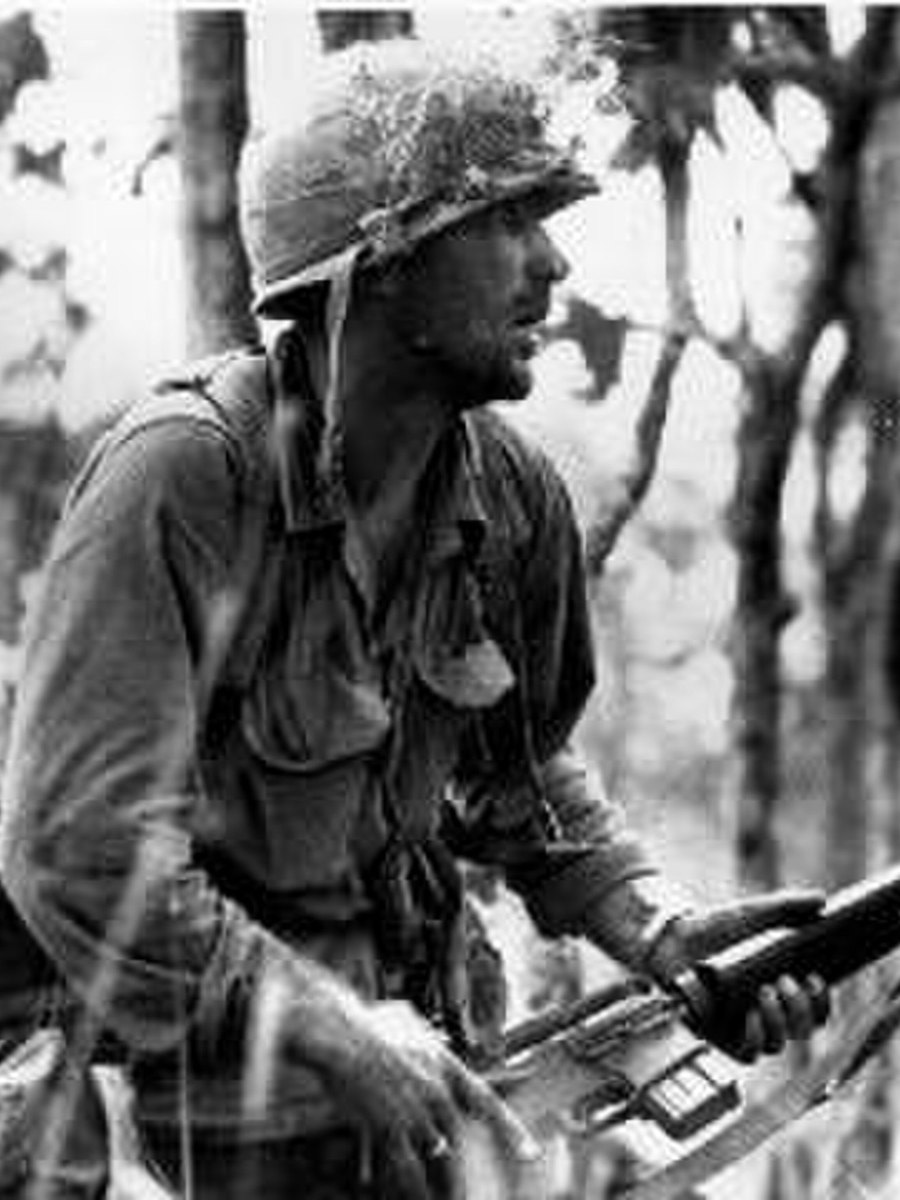
In November 1965 he led a platoon of B Company, 2nd Battalion, 7th Cavalry, 1st Cavalry Division, at the Battle of Ia Drang — the first major battle between American and North Vietnamese forces. His men called him “Hard Core.” Lt. Col. Hal Moore, who commanded at Ia Drang, called him “the best platoon leader I ever saw.” He became known for an unusual habit under fire: he sang to his men, old Cornish and British songs, to steady their nerves in the middle of combat. He earned the Silver Star, the Bronze Star with Oak Leaf Cluster, the Purple Heart, and the Vietnamese Cross of Gallantry, and became a U.S. citizen in 1967. He stayed in the Army Reserve, retiring as a colonel in 1990, and went to work in corporate security for Dean Witter at the World Trade Center. By then, singing under pressure was not a trick. It was simply who he was.
Rescorla had already lived through one attack on the World Trade Center: the 1993 bombing, when he personally led his firm’s evacuation from the South Tower. Rather than treat it as a one-time scare, he became convinced the buildings remained a target — and grew specific about how the next attack might come, including the possibility of an aircraft. After Dean Witter merged with Morgan Stanley, he advised the firm to move out of the complex. The firm, the largest tenant in the South Tower, wasn't going to move. So he did the next best thing: he trained the people who couldn't leave.
For years, Rescorla ran evacuation drills every three months that employees grumbled about — timed walks down the stairwells, two by two, no elevators, no exceptions, regardless of how it disrupted the trading floor. Executives complained about the cost in lost productivity. He held the drills anyway. It is the same discipline that shows up in anyone who has decided, quietly and without asking permission, to prepare for a day they hope never comes.
On the morning of September 11, 2001, Rescorla was on the 44th floor of the South Tower when the North Tower was struck. A Port Authority announcement told occupants of the South Tower to remain at their desks — the building was safe, it said. Rescorla, who had spent years preparing for exactly this moment, did not wait for permission. He grabbed a bullhorn and a walkie-talkie and began ordering Morgan Stanley employees on all 22 of the firm’s floors down the stairwells, two by two, exactly as they had drilled.
Then the second plane hit the South Tower itself, just above the floors he was clearing. The building shook. Panic started to spread in the stairwells. Rescorla's voice cut through it — first with instructions, then with song — “God Bless America” over the bullhorn, and “Men of Harlech,” an old Welsh battle hymn, the way he had once sung to his soldiers in Vietnam. Employees who lived to tell the story remember filing down dozens of flights of stairs listening to a sixty-two-year-old security chief sing to them like it was any other drill.
As soon as I make sure everyone else is out.
— Rick Rescorla, when a coworker told him to evacuate, September 11, 2001 · U.S. Army, 2015By the time nearly all of Morgan Stanley's 2,700 employees were out, colleagues told Rescorla he had done what he needed to do — it was time to leave. He pointed back up the stairwell. He was last seen on the tenth floor, heading up with his security team, looking for anyone left behind. The South Tower collapsed at 9:59 a.m. He did not come out.
During the evacuation, Rescorla managed to call his wife, Susan. It was, by every account she has given since, a goodbye. He told her not to cry, that he needed to finish getting his people out safely, and then he said the words she has carried ever since.
If something happens to me, I want you to know I've never been happier. You made my life.
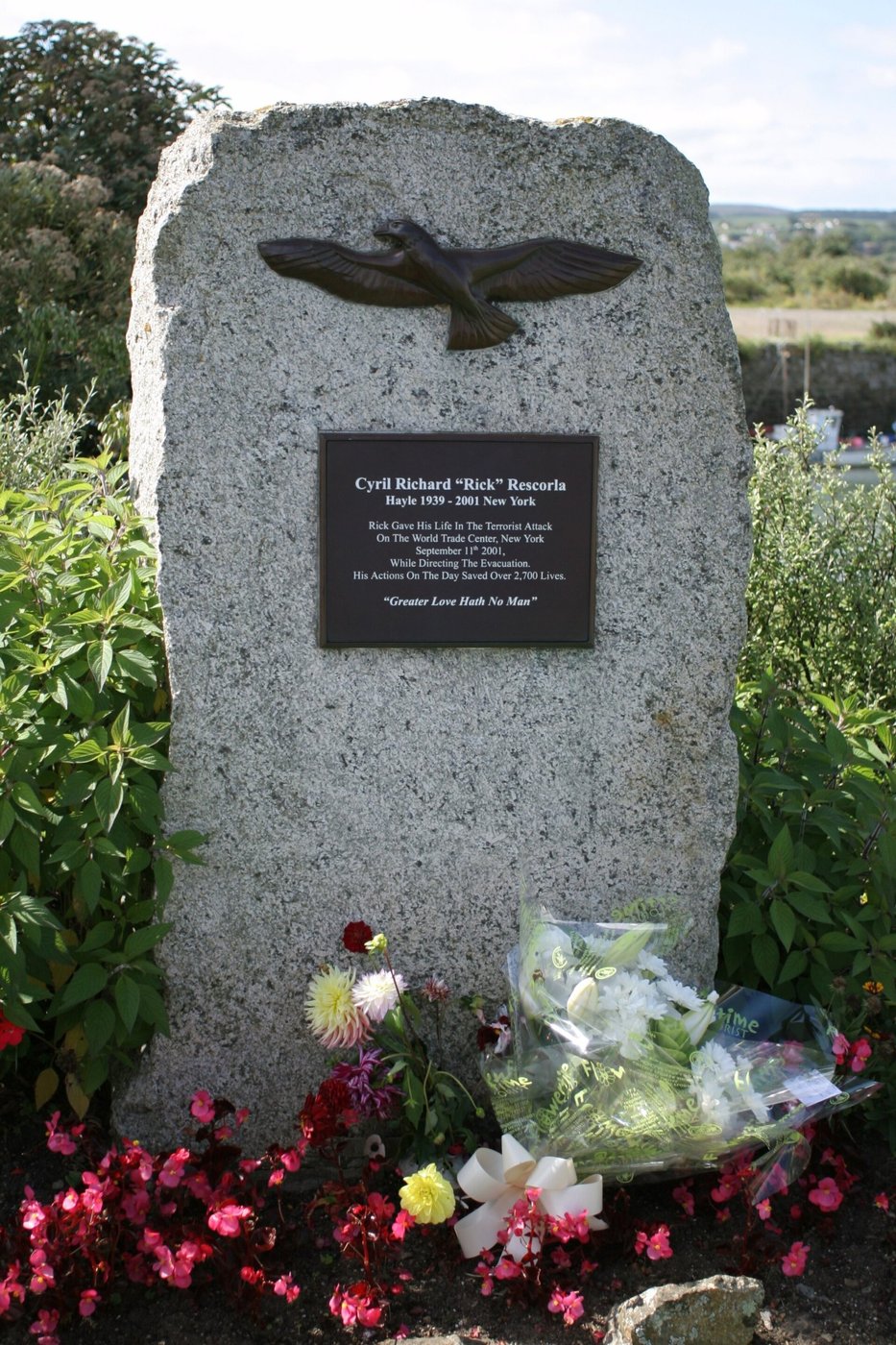
— Rick Rescorla, final phone call to his wife Susan, September 11, 2001 · U.S. Army, 2015Rescorla's body was never recovered. His name is inscribed on Panel S-46 of the National September 11 Memorial, where a white rose is placed beside it on his birthday, May 27. In 2019 he was posthumously awarded the Presidential Citizens Medal. In his hometown of Hayle, a granite memorial topped with a bronze eagle carries his name and five words of Scripture: “Greater Love Hath No Man.” But the truest monument to Rick Rescorla is a number: roughly 2,700 people who walked out of the South Tower alive because a security chief refused to stop insisting, year after year, drill after unpopular drill, that the worst could happen and that being ready mattered more than being liked.
This archive exists for the moments before the emergency, not just the moment of it. Rescorla's real courage wasn't only the bullhorn and the singing on September 11 — it was the years of being the guy who wouldn't let people get comfortable, who kept running drills everyone else thought were a waste of time. Anyone preparing for a hard season they can feel coming — a diagnosis, a layoff, a fight they know is on the way — can take something real from that: the discipline that looks unnecessary right up until the day it saves everyone in the building.
“He spent years drilling people who thought he was overreacting. On the one day it mattered, nearly everyone he was responsible for walked out alive. The Best of America™ will not forget him.”
Become a Founding Local Patriot Business™ → · Sponsor this profile and ensure no American hero is ever forgotten