He put his own plane down on a frozen mountainside, on purpose, beside a burning wreck — and would not leave his wingman while there was still a chance.
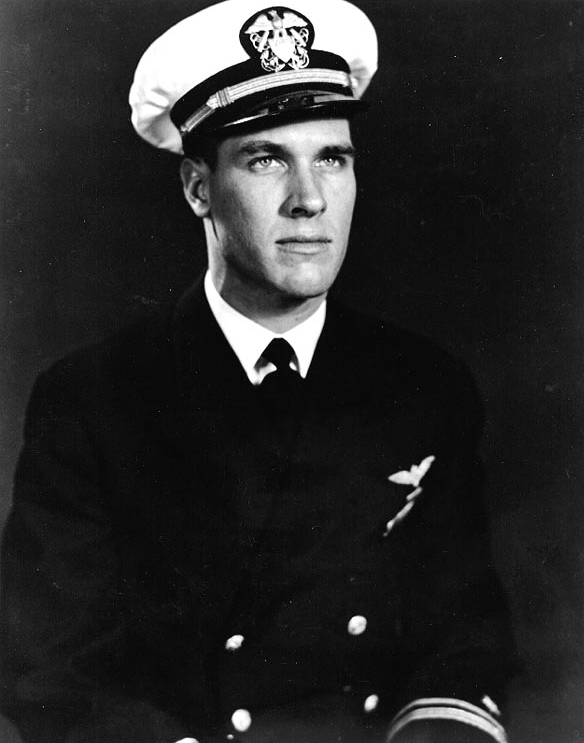
Thomas Jerome Hudner Jr. was born August 31, 1924, in Fall River, Massachusetts. He attended Phillips Academy in Andover and graduated from the United States Naval Academy in 1946. At first he had no interest in aviation — but he learned to fly, and by the outbreak of the Korean War he was a lieutenant (junior grade) flying the F4U Corsair with Fighter Squadron 32 off the aircraft carrier USS Leyte.
His wingman was Ensign Jesse L. Brown, the Navy's first African American naval aviator. The two men flew together off Korea from October 1950, supporting Marines on the ground in some of the hardest fighting of the war.
On December 4, 1950, near the Chosin Reservoir, Brown's Corsair was struck by ground fire and forced down in the snow, deep behind enemy lines, in subzero cold. Hudner circled the wreck, saw his wingman alive but trapped, and made the decision no training manual asks a pilot to make: he would put his own aircraft down beside him.
He jettisoned his ordnance and made a deliberate wheels-up belly landing on the rough, snow-covered mountainside, in the presence of enemy troops. He injured his back in the landing. Then, with his bare hands, he packed snow on the burning fuselage to keep the flames from the trapped pilot, and struggled to pull Brown free. The crushed cockpit held him fast.
Hudner went back to his own wrecked aircraft, radioed for a helicopter with an ax and a fire extinguisher, and returned to the fight. When the rescue helicopter, flown by Lt. Charles Ward, arrived, the two men worked for about 45 minutes to cut Brown free. As darkness and deadly cold closed in, they were forced to leave. Brown died on the mountain.
“We had no choice but to leave him. I was crushed.”
Thomas J. Hudner Jr. · Recalling December 4, 1950On April 13, 1951, President Harry S. Truman presented Hudner the Medal of Honor at the White House. Brown's widow, Daisy, was there to congratulate him. Hudner had flown 27 combat missions in Korea.
“For conspicuous gallantry and intrepidity at the risk of his life above and beyond the call of duty as a pilot in Fighter Squadron 32, while attempting to rescue a squadron mate whose plane struck by antiaircraft fire and trailing smoke, was forced down behind enemy lines. Quickly maneuvering to circle the downed pilot and protect him from enemy troops infesting the area, Lt. (j.g.) Hudner risked his life to save the injured flier who was trapped alive in the burning wreckage. Fully aware of the extreme danger in landing on the rough mountainous terrain and the scant hope of escape or survival in subzero temperature, he put his plane down skillfully in a deliberate wheels-up landing in the presence of enemy troops. With his bare hands, he packed the fuselage with snow to keep the flames away from the pilot and struggled to pull him free. Unsuccessful in this, he returned to his crashed aircraft and radioed other airborne planes, requesting that a helicopter be dispatched with an ax and fire extinguisher. He then remained on the spot despite the continuing danger from enemy action and, with the assistance of the rescue pilot, renewed a desperate but unavailing battle against time, cold, and flames. Lt. (j.g.) Hudner's exceptionally valiant action and selfless devotion to a shipmate sustain and enhance the highest traditions of the U.S. Naval Service.”
Hudner stayed on active duty for another 22 years, including a tour as executive officer of the aircraft carrier USS Kitty Hawk during the Vietnam War, and retired as a captain in 1973. From 1991 to 1999 he served as Massachusetts Commissioner of Veterans' Services, and he stayed close to Jesse Brown's family for more than half a century.
On February 17, 1973, the Navy commissioned the destroyer escort USS Jesse L. Brown in his wingman's name; Hudner remained a friend to her crew, and in 1985 they named the ship's crew lounge the "Hudner Room." In July 2013, at 88, he traveled to North Korea seeking Brown's remains. They were never recovered. The guided-missile destroyer USS Thomas Hudner (DDG-116) bears his name, and the Hudner–Brown story reached a new generation in the 2022 film Devotion.
Thomas J. Hudner Jr. died November 13, 2017, at his home in Concord, Massachusetts. He was 93. He was laid to rest with full military honors at Arlington National Cemetery on April 4, 2018. He was the last living Navy Medal of Honor recipient of the Korean War.
He went down on purpose, into enemy country, for a shipmate he could not save —
and stayed until darkness made staying impossible.